
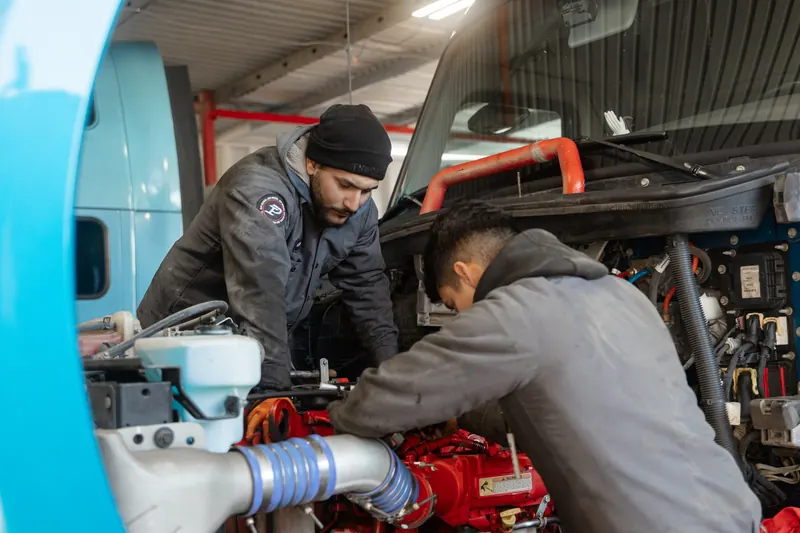
A heavy-duty transmission usually warns you before it quits. Slipping, grinding, leaks, delayed engagement, and heat are the big ones. Some are mechanical and some are electronic, so the first job is figuring out which. The sooner a tech looks at it, the better the odds of a repair instead of a rebuild.
The main warning signs
Fluid leaks
Oil under the truck or wet seals on the case mean something is losing lubricant. Common leak points are the input and output shaft seals, the pan or cover gaskets, cooler lines, and the speed sensor housing. A small leak turns into a low oil level, and low oil means heat and wear.
Slipping or popping out of gear
If the engine revs and the truck does not pick up speed, something is slipping. In an automatic, that can be worn clutch packs or low pressure. In a manual or automated manual, it can be a worn clutch or worn shift components. A gear that pops out under load points to worn synchronizers, shift forks, or internal gear wear.
Grinding going into gear
Grinding on a manual often means the clutch is not fully releasing, or the synchronizers are worn. On an automated manual, grinding may point to a clutch actuator or a calibration issue. Do not keep forcing it. Our transmission and clutch repair team diagnoses both.
Whine, hum, or drone
A noise that changes with gear and speed suggests worn bearings or gears. A noise that stays in neutral points to the input shaft or front bearings. A droning sound at highway speed can also come from driveline angles or a failing center bearing, so we check those too.
Delayed or harsh shifts, erratic behavior
Late engagement, bangs on shifts, or surging acceleration can come from low or degraded fluid, a failing sensor, a bad solenoid, or a software fault. Electronics play a big role in modern transmissions, so the scan tool matters as much as the wrench.
Wrong gear selected or limp mode
If the transmission will not select the gear you want, or the truck drops into a limited mode, a controller has found a fault. Codes tell us where to start. See diagnostics and electrical.
High temperature
Overheating cooks fluid and clutch material. Causes include low fluid, a clogged cooler, a stuck converter clutch, or towing and hauling beyond what the truck can handle in the current gear. If the temp gauge or warning light comes on, pull over and let it cool.
Burned or dark fluid, and low level
Fluid should look and smell like the manufacturer describes. Dark, burnt-smelling fluid, metal in the pan, or an empty reservoir are all signs of internal damage or a long-ignored leak.
Driveline wear
Rapid u-joint wear, vibration, and worn yokes can come from a failing transmission output or from driveline problems that damage it. Check the driveline when the transmission acts up.
What a shop does
- Talk to the driver. When does it happen, in what gear, hot or cold?
- Check the fluid. Level, color, smell, contamination, and the right type for that unit.
- Scan for codes. Look at stored and active faults, and live data where available.
- Inspect for leaks and external damage. Cooler, lines, mounts, wiring, and linkage.
- Road test. Reproduce the problem.
- Check the clutch and driveline on manual and automated units.
- Decide the scope. Adjustment, sensor or solenoid replacement, fluid service, or internal repair.
The aim is to rule out the cheap fixes first. Plenty of shift complaints turn out to be fluid, a sensor, a wiring fault, or a clutch issue.
What owners and drivers can do
- Check for fresh drips when you walk around.
- Watch the transmission temperature gauge if your truck has one.
- Use the fluid and the service interval the manufacturer specifies, adjusted for severe duty.
- Avoid lugging the engine and shifting aggressively under load.
- Write down when symptoms occur. Notes save diagnostic time.
- Do not clear fault codes and keep driving. We need them.
When to stop driving
Stop and call for service if the truck will not engage a gear, the transmission is overheating, fluid is pouring out, you hear grinding that continues, or the truck loses drive in traffic. Driving a slipping transmission turns a repair into a replacement, and a failed unit can leave you stranded on the freeway. Our roadside assistance team can reach you.
Prevention
Fluid and filter service, clean coolers, correct clutch adjustment where applicable, and early attention to leaks do the most good. Typical intervals vary by duty cycle, so follow the OEM schedule. Short-haul stop-and-go and heavy vocational work are harder on transmissions than steady highway miles.
Get it checked in Fontana
If your truck is slipping, grinding, or leaking, bring it to us or ask about mobile service. We can scan it, check fluid, and tell you what is going on before you commit to a repair. See our transmission and clutch repair page. Call or text (909) 549-7587.